The Information Edge

Source: Texas Signals — aggregate county data.
Real estate investing has always been an information business. The investor who knows about a motivated seller before others do, who understands neighborhood dynamics before they are obvious, who can accurately assess property values faster than the competition — that investor wins.
What has changed in 2026 is the volume and accessibility of data. Texas county clerks, appraisal districts, and municipal governments publish enormous amounts of property data: deed transfers, tax delinquencies, building permits, code violations, Lis Pendens filings, and more.
The challenge is not data availability. It is data aggregation, normalization, and actionability.
What Texas Signals Tracks
Across Austin, Dallas, Houston, San Antonio, and Fort Worth, Texas Signals monitors:
•Pre-foreclosures — Lis Pendens filings and notices of default
•Tax delinquent properties — Properties behind on property tax payments
•Code violations — Municipal code enforcement actions
•Building permits — New construction, renovation, and demolition permits
•Cash buyer transactions — Deed transfers without corresponding mortgage filings
•Zoning changes — Applications for rezoning and variance requests
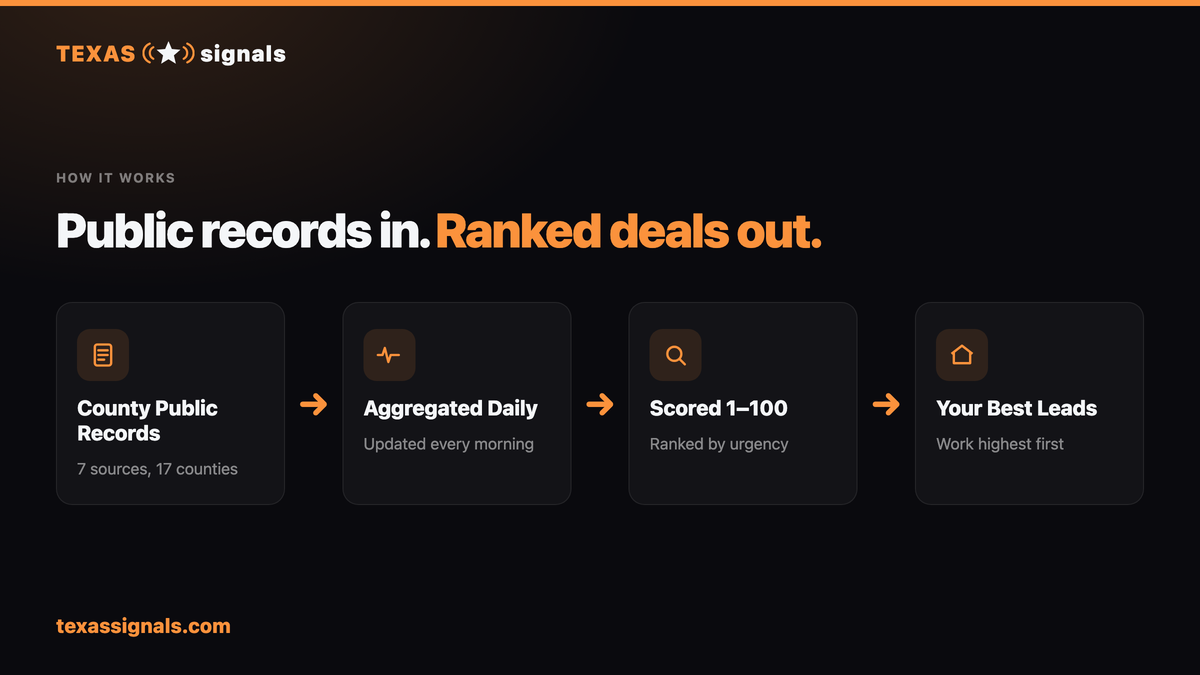
The total dataset exceeds 800,000 property records across these categories, updated daily.
How Data Changes the Game
Before Data: The Driving Model
Traditional real estate investors find deals by driving neighborhoods, looking for distressed properties (overgrown lawns, boarded windows, accumulated mail). This approach works, but it is:
•Time-consuming (hours per day in the car)
•Geographically limited (you can only drive so many neighborhoods)
•Reactive (you see the distress after it is visible to everyone)
•Random (no systematic coverage)
With Data: The Signal Model
Data-driven investors start with the database. They filter for specific distress signals across entire counties, identify properties that match their investment criteria, and then conduct targeted outreach — all before ever getting in the car.
The advantages:
•Speed — Identify distressed properties the day the filing is recorded
•Scale — Cover entire counties, not just a few neighborhoods
•Precision — Target specific distress types that match your investment strategy
•Systematic — Never miss a filing in your target area
The Cross-Reference Strategy
The most powerful use of property data is cross-referencing multiple distress signals. A single signal (tax delinquency OR code violation OR pre-foreclosure) indicates potential motivation. Multiple overlapping signals indicate high-probability motivation.
Properties that appear in two or more distress databases simultaneously represent the highest-quality leads for direct outreach:
•Pre-foreclosure + tax delinquent = Owner under maximum financial pressure
•Code violation + absentee owner = Neglected investment property
•Tax delinquent + code violation = Owner who has stopped investing in the property entirely
•Pre-foreclosure + cash buyer nearby = Active investor market with distressed inventory
Building Your Data Workflow
1.Set your criteria — Define your target metros, neighborhoods, price ranges, and property types
2.Subscribe to alerts — Get daily notifications when new filings match your criteria
3.Prioritize by overlap — Focus on properties with multiple distress signals
4.Research before contact — Pull ownership info, assess equity, estimate ARV
5.Make direct contact — Reach out to the property owner with a specific offer
6.Track your pipeline — Monitor properties through the foreclosure timeline
Source: Texas Signals — aggregate county data.
Source: Texas Signals — aggregate county data.
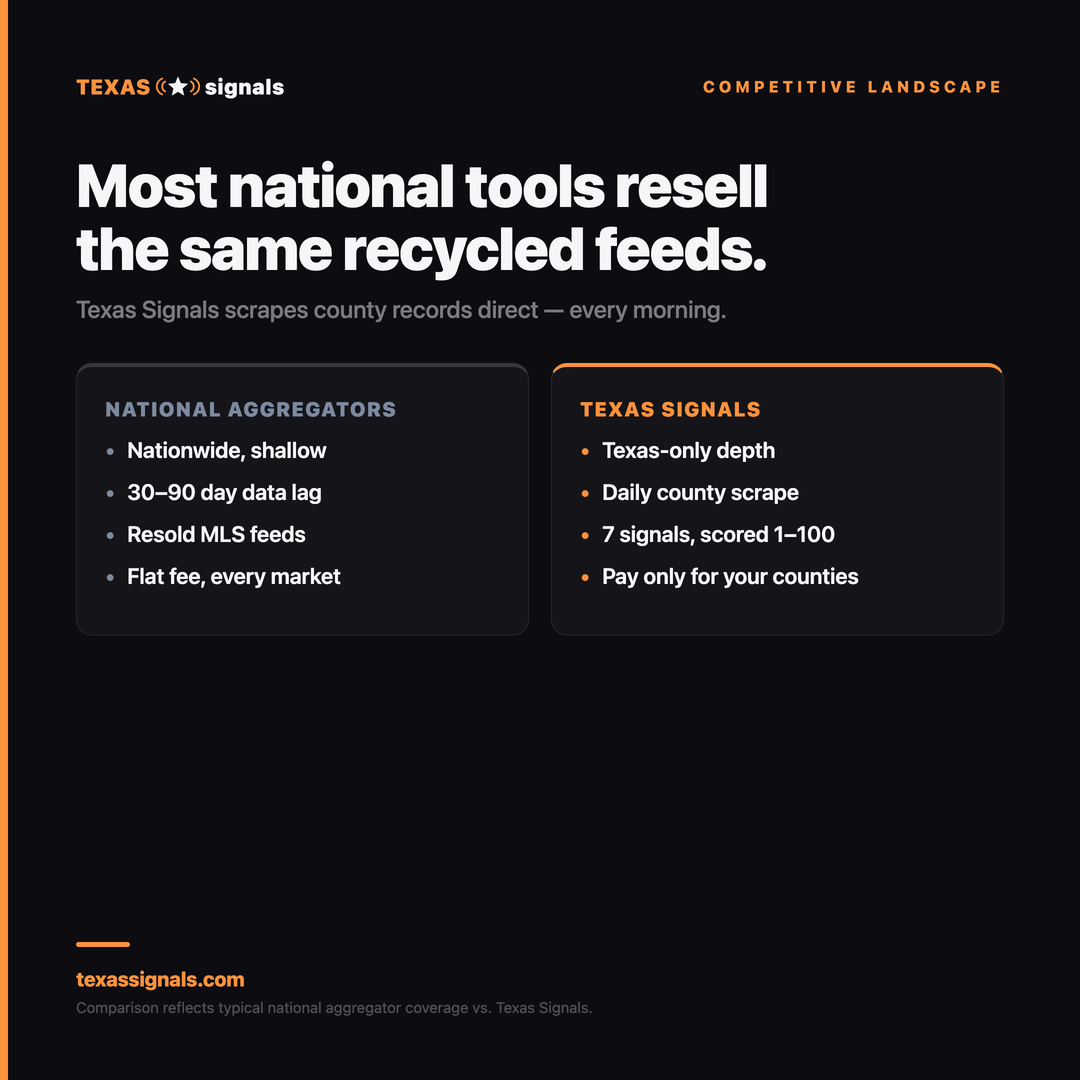
Texas Signals provides the data infrastructure for this workflow. Start tracking distressed properties across Texas at texassignals.com.